
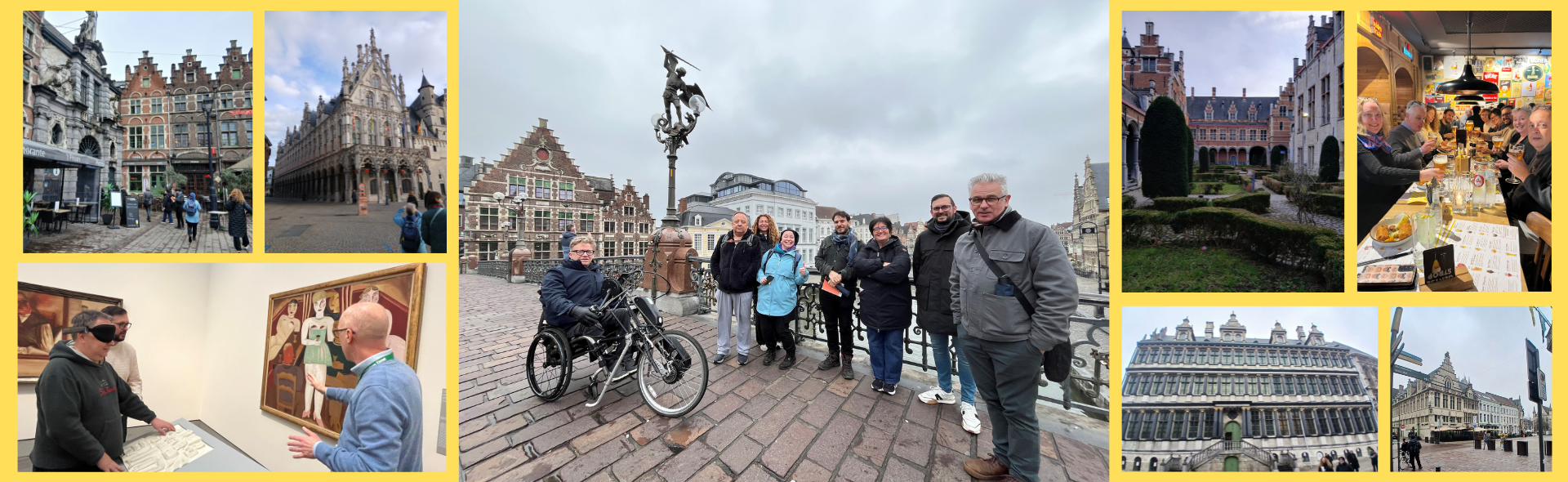
Accessible Flanders: My visit to Ghent and Mechelen
By Warren Craddock, Enable Holidays
At the beginning of February, I was fortunate enough to visit Flanders for three days as a guest of VisitFlanders tourist board in celebration their 25th anniversary. The purpose of the trip was to discover the ease of travelling to the region by Eurostar and discovering the accessibility of Ghent and Mechelen.
With the option of taking an early train out of London St Pancras to ensure I spent the maximum time in Belgium, I travelled down to London from my home in the midlands the night before. to make things easier the following morning.
All aboard the Eurostar for Brussels and beyond
Check-in for Eurostar was 1 hour 15 minutes before the train departure time, and I made my way through security at 7am with relative ease for what is usually peak travel time. Twenty minutes later, I had cleared the baggage scan, UK & French passport control and completed biometric scanning of my picture and fingerprints and was boarding the train. Refreshments are limited in the waiting room, so I would suggest getting anything you need before clearing security. There are no liquid limits so getting a meal deal and bringing it through is not a problem. Boarding was quick and simple, and it was not long before we were on our way. I travelled in Economy for this journey, though those requiring wheelchair assistance travel in Economy plus where the wheelchair spaces are located. Eurostar has now also launched a new assistance class that allows those who require assistance (unable to walk 200m unaided) but do not use a wheelchair to also have the option for assistance and seating in Economy Plus, but able to sit in a seat. The journey to Brussels was just two hours on the direct service.
On arrival at Brussels Midi south station, I changed trains and platforms for my train to Ghent. It was quick and smooth, with details clearly marked in many languages and assistance can be pre-booked for those requiring help to transfer. Within 10 minutes I was on my way for the 30-minute journey to Ghent to meet fellow members of the group from across Europe.
Following lunch, we ventured to the Ghent information office to discover what the city has to offer for accessible travel. The office is very well-equipped with lowered counters for wheelchair-users, multi-sensory walking guides in Dutch and English with tactile plates for the visually impaired and audio description/sign language for visitors with hearing impairments.
The city’s public transport system is accessible for wheelchair-users with information on the accessible stops along the way, including a red, yellow, green route system to identify the types of cobbled streets (with green being the most accessible). As cars are excluded from most of the city centre, cycles are everywhere – and available to hire as pedal and electric as well as hand bikes for people with limited mobility.
After exploring the city, we visited Saint Bavo's Cathedral, home to some outstanding historical artwork, including the famous Mystic Lamb. The virtual reality tour for the Mystic Lamb charts the history of this painting from its conception to present day – a remarkable experience which concludes with a visit to the famous masterpiece piece itself. This is the perfect way to really appreciate art, even for people who are not normally art lovers. I found myself being immersed into history like I’ve never experienced before - it was so attention-compelling from start to finish and I cannot recommend it enough.
We checked into the Ibis Cathedral Hotel for an overnight stay, which gave me the opportunity to complete the Enable Holidays’ accessibility audit of the hotel and adapted rooms before an informative presentation by Visit Flanders and a walk through of their first-class website which is rich in detail on accessibility in the region – the result of 25 years of hard work!
From fine arts to walls that talk
We started day two with a visit to the Hotel Den Briel, a purpose-built property that offers so much more than just mobility assistance. The hotel is connected to the local hospital, yet whilst it offers fully accessible rooms, assistance care and basic nursing options, it still feels very much like a hotel rather than a clinical centre. The hotel is located a little further out of the city centre but that’s not really an issue as there’s a fully accessible tram stop right outside the property.
Our next destination was the MSK museum of fine arts, a barrier-free complex that also offers tours and sensory baskets for the visual impaired and includes a restaurant. The museum features fine arts from the middle-ages to the present day.
Next stop was the city of Mechelen. The city is easily reached by accessible train from Brussels airport (around 15 minutes) or via trains from Brussels (around 30 minutes). Mechelen is a lesser-known historical city that’s certainly worth visiting as an alternative to Bruges or Brussels.
The fully accessible tourist office was a mine of information on the various tours and places of interest to visit. One such tour, and one I cannot recommend enough, is the “If walls could talk” tour. This immersive listening walk allows you to "eavesdrop" on historical characters from the year 1473. Available for anyone with mobility, visual or hearing impairments, it is a great way to explore the city through a listening walk of history to various information points around the city. There are options for 2km, 3km and 3.5km routes, and you will also receive a map that identifies any possible obstacles for wheelchair-users, as well as options for those with visual or hearing impairments, and learning difficulties. There’s also a step-by-step guide to help visitors with autism prepare for their visit. This innovative pay-what-like system enables you to pay what you think is a fair price or what you can afford to pay. All of the money collected is then donated to local communities.
After a busy but enjoyable day it was time to check into the B&B Hotel Mechelen, where I also undertook an accessibility audit for Enable Holidays’ records.
Accessible history and networking for the future
After breakfast on the third day, we visited Hof van Busleyden museum to discover an art collection dating back 600 years and to review its accessible facilities, which included quiet tours for people with autism. The museum offers something for everyone, including interactive gold boxes for enhancing the experience for families.
Before heading to Speelgoedmuseum (the toy museum) for a networking lunch with local hoteliers, there was just time for me to do one last accessibility audit at the Novotel Mechelen. To wrap up the trip, I took the train to Brussels Midi station, where I connected with the Eurostar for my return to London. This time, however, I had an Economy Plus ticket, which includes an onboard meal - so no need to stock up with snacks for the journey. Flanders was a truly amazing experience that was so easy to reach from the UK. I am now looking forward to sharing my experiences with everyone and helping you plan the perfect city break. Whether choosing Ghent or Mechelen (or both) you will not be disappointed. Flanders has embraced accessible travel in a way many places have not, maintaining its history, culture, stunning scenery and social life to suit all ages. A big thank you to all at VisitFlanders for the opportunity to visit an amazing region and the ability to bring it to life for others.
Sign up for our email updates and get the latest holidays, news and offers
Sign up today Guaranteed adapted rooms
 Adapted taxi transfers
 100% tailor-made holidays to suit your specific needs
 All properties audited - all the information you need